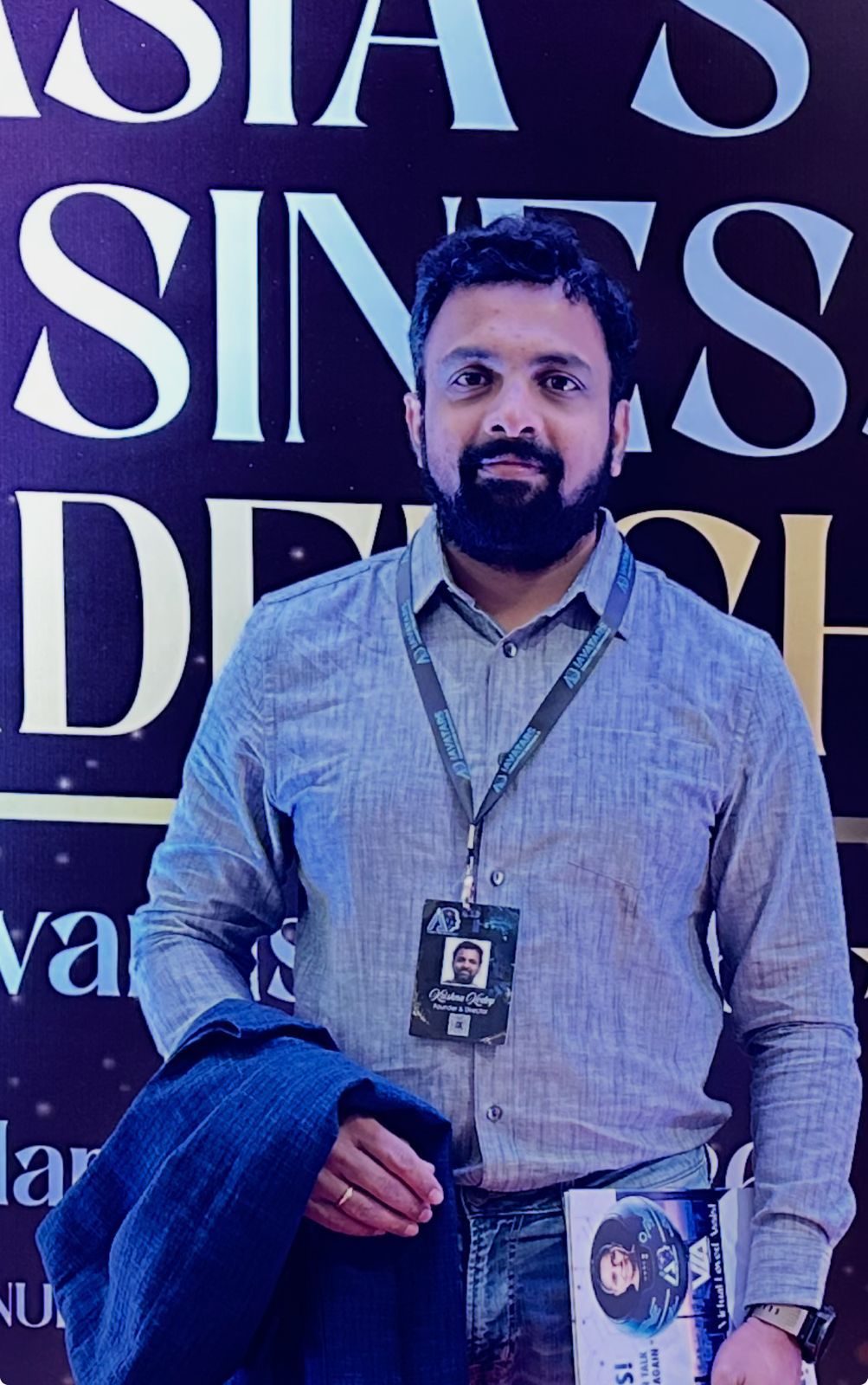
In a small but growing corner of the artificial intelligence industry, a category of products is emerging with no real precedent: physical devices that let people interact with AI-generated avatars of loved ones, whether those individuals live thousands of miles away or are no longer alive. At the centre of this category is iAVATARS, a startup registered in Michigan, United States, that has spent the last two years quietly building what it calls "the world's first AI human avatar device," and what the company describes as the first AI smart and healthcare tech gadget of its kind anywhere in the world. iAVATARS is founded and led by Indo-Canadian entrepreneur Dr Krishna.
The company's emergence comes at a moment when India's AI startup ecosystem is experiencing unprecedented momentum. According to industry estimates, India is now home to thousands of AI-focused startups, with investment in the sector accelerating sharply over the past three years. Yet within this crowded landscape, most ventures cluster around a handful of familiar categories: enterprise productivity tools, generative content platforms, customer service automation, and large language model applications. iAVATARS has taken a markedly different path, one that combines hardware, proprietary AI software, and an emotionally driven use case that few companies have been willing to address: human grief, distance, and memory.
"Most AI companies are solving for efficiency," said Dr Krishna, the company's founder. "We set out to solve for something that technology has never really tried to solve: the feeling of absence." For families separated by distance, and for those who have lost someone they love, Dr Krishna says iAVATARS is built around a simple promise: the ability to talk to them again, not as a recording, but as a responsive, living presence that offers emotional support and comfort on demand. As of 2026, the company believes it remains the only solution of its kind built specifically around that promise.
That ambition is now backed by intellectual property protection across five jurisdictions. iAVATARS holds a Patent Cooperation Treaty (PCT) application pending simultaneously in the United States, the European Union, India, Australia, and New Zealand, a relatively rare achievement for an early-stage startup, and one that signals both the novelty of the underlying technology and the seriousness with which the company is approaching global expansion. PCT filings of this breadth are typically associated with companies several funding rounds ahead of where iAVATARS currently sits, and the company says the decision to file early was deliberate.
"When you build something that has never existed before, protecting it becomes as important as building it," Dr Krishna said. "We did not want to spend three years validating a product category only to have it replicated by a larger company with more capital."
At the core of iAVATARS' offering is iSoul 1.0, the company's proprietary AI engine, which powers a small lineup of hardware devices: the iA VLA Basic and iA VLA Pro, both tabletop displays designed for everyday family use. Unlike most consumer AI products on the market, iAVATARS' devices are designed to function fully offline, with all personal data, including voice recordings, video, and interaction history, stored locally on the device rather than in the cloud. The company positions this as both a privacy safeguard and a practical necessity, given that many of its target users are elderly individuals in regions with inconsistent internet connectivity.
The business case driving iAVATARS rests on a demographic reality that is reshaping economies across the world, India included. The country is home to an estimated 140 million citizens aged 60 and above, a number projected to more than double by 2050. Simultaneously, India's diaspora, now estimated at over 18 million people living abroad and part of a broader global figure of roughly 270 million people living away from their country of origin, has created a structural gap between ageing parents and adult children separated by geography. Add to this a broader global trend: the World Health Organisation has flagged loneliness as a significant public health concern, with research linking chronic loneliness in older adults to accelerated cognitive decline. iAVATARS is positioning itself directly at the intersection of these trends, betting that the AI companion device market, projected by several industry analysts to reach roughly USD 12 billion by 2030, still lacks a category-defining hardware player.
"There is no shortage of software assistants," Dr Krishna said. "What does not exist yet is a dedicated physical device built specifically around presence, memory, and emotional continuity. That is the gap we are filling."
For now, iAVATARS remains a small company by most conventional startup metrics. Its team is lean, its devices are not yet mass-distributed, and its primary visibility has come through grassroots outreach rather than large-scale marketing. The company has, for instance, been visiting old-age homes across Mumbai this month, not to sell its product but to engage directly with elderly residents, document their stories, and lay the groundwork for future demonstrations of its technology in institutional care settings.
This ground-level approach is, according to Dr Krishna, intentional rather than incidental. "You cannot understand whether something genuinely helps an elderly person feel less alone by running a lab demo," he said. "You have to sit with them, listen to them, and see how they respond when it is real." Rather than launching through traditional e-commerce or large retail partnerships, the company is exploring institutional channels first: senior living communities, hospice care networks, and potential tie-ups with NRI-focused service providers who already work with families managing care for ageing parents from abroad.
India's broader AI investment climate offers both an opportunity and a challenge for a company positioned the way iAVATARS is. Capital flowing into Indian AI startups has grown substantially over the past few years, with several funds explicitly seeking differentiated, IP-backed ventures rather than incremental software wrappers built atop existing large language models. iAVATARS' PCT filing across five jurisdictions is likely to be a meaningful talking point in future fundraising conversations, given how few seed-stage companies secure such broad patent coverage. At the same time, hardware-driven startups generally face longer development cycles and higher capital requirements than pure software companies, a reality that has made many Indian investors cautious about hardware bets in the past.
Dr Krishna acknowledges the trade-off but argues that the category iAVATARS justifies the longer build cycle. "If this were easy to build quickly, someone would have built it already," he said. "The fact that nobody has combined offline AI, personalised avatars, and dedicated hardware into one coherent product is precisely the opportunity. But it does mean we have had to be patient and disciplined about how we spend capital."
That discipline is visible in the company's current operating structure. Rather than scaling headcount aggressively, iAVATARS has kept its core team small and cross-functional, with each senior member covering a wide remit. Swatika's role spans strategic partnerships and broader business operations, reflecting the realities of an early-stage team where rigid departmental boundaries are a luxury it cannot yet afford. Sundeep has driven much of the company's go-to-market thinking, including early conversations with potential institutional partners, while Rohit has focused on building the operational systems needed to track device deployment, customer feedback, and after-sales support ahead of a wider release. Bhargava's work on product strategy has involved frequent direct interaction with prospective users, including elderly residents and family members engaged with during the company's outreach visits, feeding that input back into product design decisions.
On the technical side, Arjit, who serves as Head of Technical and R&D Lead, has overseen the development of iSoul 1.0 and the broader engineering roadmap behind the company's device lineup, an effort spanning AI model development, hardware integration, and the offline-first architecture that distinguishes iAVATARS from cloud-dependent competitors. Building an avatar system that can render a recognisable, emotionally resonant likeness of a real person, while keeping all processing local to the device, has required Arjit's team to balance model size, processing efficiency, and visual fidelity in ways that cloud-dependent rivals do not need to consider.
For Dr Krishna, though, the calculus remains rooted less in market timing than in a personal conviction that has driven the company since its earliest days. "I am not trying to build a faster way to chat with an AI," he said. "I am trying to build a way for someone to feel less alone, even briefly, even imperfectly. If we get the business right, that is a bonus. But the reason this company exists is the feeling, not the forecast."
Website:- iavatars.ai